Ball python · enclosure
Ball python tank size and setup
How big the vivarium should be for your snake’s length, what research found about racks and tubs, and how to fit it out. UK welfare guidance and vet sources compared.
One adult ball python needs at least
- Adult vivarium120 × 60 × 60 cm48 × 24 × 24 in, the Royal Veterinary College minimum
- Length ruleAs long as the snakeWidth and height at least a third of its length (RSPCA)
- US care sheets40 gallonsA 40-gallon breeder tank is only about 91 cm (36 in) long (PetMD, Petco)
- HidesSnug, at both endsPlus one with damp moss. Chewy suggests three (RSPCA, PetMD, Chewy)
- Humidity50–60%Measured at the cool end (RSPCA, RVC)
- HousingOne per vivariumBall pythons are solitary (RSPCA)
Every source says bigger is better. The UK sources also tie the size to the snake: it must be able to stretch out fully.
Tank size
How big should a ball python enclosure be?
RSPCA says a royal python needs a vivarium big enough to stretch out fully, with width and height of at least a third of the snake’s length. So a 120 cm snake needs at least 120 × 40 × 40 cm. Source: RSPCA The Royal Veterinary College sets an adult minimum of 48 × 24 × 24 in, about 122 × 61 × 61 cm. Source: RVC
| Source | Adult minimum | Notes |
|---|---|---|
| Royal Veterinary College | 48 × 24 × 24 in (about 122 × 61 × 61 cm) | About 120 US gallons. “The largest vivarium possible” |
| RSPCA | As long as the snake; width and height a third of its length | Young snakes: enclosures that grow with them, or small spaces inside a larger vivarium |
| Animal Welfare Committee | Length 1×, width ⅔×, height ⅓× the snake’s length | For pet shops, and for no more than 14 days. Not a long-term size |
| PetMD, Petco, Chewy | 40 gallons or larger | Juveniles 10 to 20 gallons. A 40-gallon breeder tank is about 91 × 46 × 41 cm (36 × 18 × 16 in) |
Minimum size from your snake’s length
Measure your snake first. The UK government’s welfare advisers say to measure the live snake, not a table, and to round up. Source: Animal Welfare Committee
| Snake length | RSPCA rule (a home) | Pet-shop minimum (14 days at most) |
|---|---|---|
| 60 cm (2 ft) | 60 × 20 × 20 cm (24 × 8 × 8 in) | 60 × 40 × 20 cm (24 × 16 × 8 in) |
| 90 cm (3 ft) | 90 × 30 × 30 cm (35 × 12 × 12 in) | 90 × 60 × 30 cm (35 × 24 × 12 in) |
| 120 cm (3.9 ft) | 120 × 40 × 40 cm (47 × 16 × 16 in) | 120 × 80 × 40 cm (47 × 31 × 16 in) |
| 150 cm (4.9 ft) | 150 × 50 × 50 cm (59 × 20 × 20 in) | 150 × 100 × 50 cm (59 × 39 × 20 in) |
| 180 cm (5.9 ft) | 180 × 60 × 60 cm (71 × 24 × 24 in) | 180 × 120 × 60 cm (71 × 47 × 24 in) |
Young snakes can live in a big vivarium if it has plenty of cover and small, snug spaces. Source: RSPCA Chewy advises buying the largest enclosure you can at the start rather than upgrading. Source: Chewy
The research
Why space matters: racks, tubs and stretching out
Many breeders keep ball pythons in racks: shelves of plastic tubs, often with no light. Three pieces of UK and European work looked at what that does to snakes.
Snakes need to stretch out
The UK’s Animal Welfare Committee found that even its pet-shop minimum restricts normal movement. It said snakes should be kept at that size for no more than 14 days, and that three months is not reasonable. Extra decoration is no substitute for space. Source: Animal Welfare Committee
Racks stop normal behaviour
A 2021 study moved 35 ball pythons from a rack into furnished terrariums. Basking, climbing, burrowing and bathing happened only in the terrariums. In the rack, snakes spent about 11.6% of the day pushing their snouts against the walls, against 0.04% in the terrariums. Source: Hollandt and others, 2021
More signs of stress
A University of Bristol survey of pet snakes found that snakes unable to stretch out fully showed more clinical signs than snakes that could. Source: Cargill and others, 2022
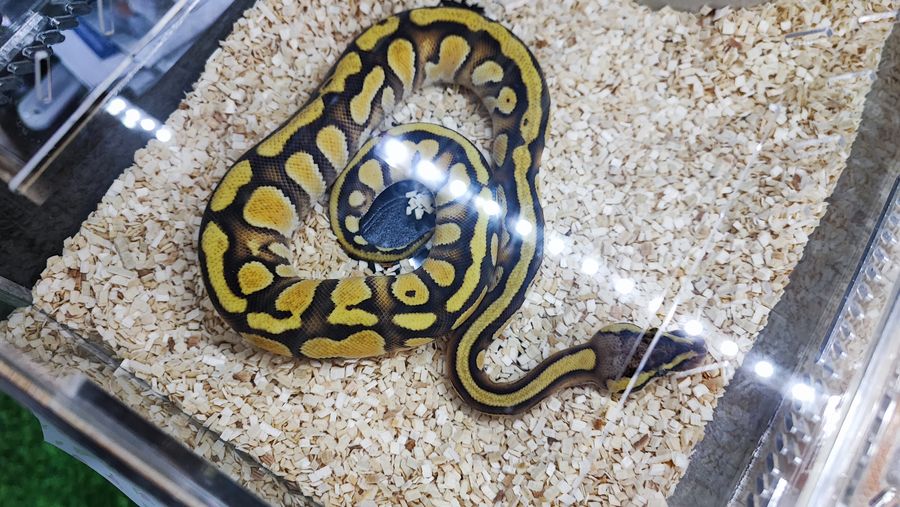
Choosing one
What to look for in a ball python vivarium
A secure lid
Ball pythons are escape artists that squeeze through small gaps. Source: Chewy PetMD wants a secure, screened lid. Source: PetMD
Holds humidity, still airy
The Royal Veterinary College recommends wooden or fibreglass vivariums, with extra air holes if needed. Source: RVC If humidity runs too high, add ventilation to stop mould and bacteria. Source: RSPCA
Opens at the front
Lift your snake out from the front. A hand coming from above can look like a predator and trigger a defensive strike. Source: Chewy
Length first, then height
Length lets your snake stretch out. Source: RSPCA Height lets it climb: many ball pythons enjoy sturdy branches. Source: PetMD, RVC
Snug hides
Each hide should fit the snake but be small enough that its body touches the sides when coiled. Source: RSPCA Too little cover is a common reason ball pythons stop eating. Source: Chewy
Room for a deep floor
RSPCA suggests an organic soil that holds humidity, and a bioactive setup for a permanent home. Source: RSPCA
Layout
How to lay out a ball python enclosure
Heat at one end and cool at the other, with snug hides along the way, so your snake can choose its temperature and still feel hidden. Source: RSPCA, RVC
- 1Guarded 60–100 W heat lamp pointing down, on a thermostat with its probe at snake level
- 2A sturdy branch or rock under the basking spot
- 3A low-output 2 to 7% UVB tube in the roof at the hot end, over a third to a half of the length
- 4Warm hide, snug enough that the coiled snake touches the sides
- 5Humid hide with damp moss. PetMD and Chewy put it on the warm side
- 6Cool hide
- 7A water bowl big enough to soak in fully, at the cool end, changed daily
- 8A digital thermometer at each end. Check both ends every day
- 9Hygrometer at the cool end
Floor
The best substrate for a ball python
A good floor holds some moisture without staying wet. Too damp and dirty a floor can cause blisters on the belly; too dry can cause stuck shed. Source: VCA
| Floor covering | Verdict | What the sources say |
|---|---|---|
| Organic reptile soil | Good | Holds humidity (RSPCA). |
| Cypress mulch | Good | Listed by the Royal Veterinary College, PetMD and Chewy. |
| Orchid bark or wood chip | Good | Listed by the Royal Veterinary College. |
| Coconut husk | Good | Listed by PetMD and Chewy. |
| Aspen shavings | Safe | Listed by the Royal Veterinary College, PetMD, Petco and Chewy. PetMD and Petco say replace it weekly. |
| Reptile carpet | Safe | Listed by PetMD, Petco and Chewy. |
| Newspaper or paper towel | Short term | Fine for a short time only (RVC). Useful for quarantine. |
| Bioactive (living soil and plants) | Research first | Suggested for a permanent home; read up before you start (RSPCA). |
| Sand | Avoid | Not recommended: it may irritate the skin (RSPCA). |
| Pine or cedar | Never | Their oils irritate the skin (PetMD, Petco, Chewy). |
What goes inside
Ball python setup checklist
Everything an adult setup needs, with the guidance each item comes from.
- Heat lamp: 60–100 W, pointing down, with a guard. Source: RSPCA
- Night heat that gives no light: a ceramic heater or reptile radiator. Source: RSPCA
- A thermostat on every heater, with the probe above the floor at snake level. Source: RSPCA, RVC
- UVB tube: low output, 2 to 7%, with a reflector. Source: RSPCA The Royal Veterinary College asks for low-level UVB. Source: RVC
- Plug-in timer: 12 hours on, 12 hours off. Source: RSPCA, RVC
- Two digital thermometers, one at each end, and an infrared thermometer for daily checks at snake level. Source: RSPCA
- Hygrometer to check humidity. Source: RSPCA, RVC, PetMD
- Snug hides at both ends, plus one with damp moss. Source: RSPCA, PetMD Chewy suggests a third hide in the middle. Source: Chewy
- Water bowl big enough for the snake to soak in fully. Source: RVC, RSPCA
- Sturdy branches, strong enough for a heavy snake. Sterilise natural branches with boiling water. Source: RSPCA
- Substrate that holds humidity. Source: RSPCA
- Long feeding tongs. Source: RSPCA, PetMD
- Door lock or wedge, as ball pythons are good at escaping. Source: Chewy
Company
Can ball pythons live together?
No. Ball pythons are solitary and should be housed alone. Source: RSPCA, PetMD Housing two together can cause stress and competition and can put them off their food. Source: Petco
- Never house different species together. Source: PetMD
- Keep pythons and boas apart: boas can carry a deadly virus for over a year without signs, and pass it to pythons. Source: VCA
Cleaning
How often to clean a ball python enclosure
As soon as you see it
Remove droppings, urates and soiled substrate. Source: RSPCA, RVC, Chewy
Every day
Change the water, and change it at once if your snake soils it. Source: RSPCA, RVC
Every month
Take everything out, clean it with a reptile-safe disinfectant, rinse well and let it dry before your snake goes back. Source: RSPCA, RVC, Chewy
Wash your hands with soap after handling your snake or anything in its vivarium. Reptiles can carry salmonella. Source: RSPCA, RVC
Before it comes home
Test the setup, then settle your snake in
Run it for a week
Set up and run the vivarium for a week before your snake arrives. Source: RSPCA
Check both ends every day
Read the warm and cool ends with an infrared thermometer at snake level, and cross-check with digital thermometers. Source: RSPCA
Let it move in by itself
Put the travel box inside the vivarium and open it. Close the door and turn the lights off until the next morning. Source: RSPCA
Leave it alone for a week
No handling for the first week. Source: RSPCA
Questions people ask
Enclosure questions
What size tank does a ball python need?
At least 48 × 24 × 24 in (about 120 × 60 × 60 cm) for an adult (RVC), and at least as long as the snake, with width and height of a third of its length (RSPCA).
Is a 40 gallon tank big enough for a ball python?
It meets the PetMD and Petco minimum, but a 40-gallon breeder tank is only about 91 cm (36 in) long. Most adults are longer than that, and RSPCA says the vivarium should be as long as the snake. Use it for a juvenile only.
Is a 4 × 2 × 2 enclosure big enough?
It matches the Royal Veterinary College minimum (48 × 24 × 24 in). By the RSPCA rule it suits a snake up to about 120 cm. A larger female needs a longer vivarium.
Can a baby ball python live in a big enclosure?
Yes, if it has plenty of cover. RSPCA suggests several small, confined spaces inside a larger vivarium. PetMD and Petco start juveniles in 10 to 20 gallons.
Are racks or tubs OK for ball pythons?
Research found that ball pythons in racks could not bask, climb, burrow or bathe, and showed more abnormal behaviour (Hollandt and others, 2021). We suggest racks and tubs for short stays only, such as quarantine.
What is the best substrate for a ball python?
One that holds some humidity: organic reptile soil (RSPCA), cypress mulch, orchid bark or coconut husk (RVC, PetMD, Chewy). Avoid sand (RSPCA) and never use pine or cedar (PetMD, Petco).
Glass or wooden vivarium for a ball python?
The Royal Veterinary College recommends wooden or fibreglass vivariums. Glass works with a secure, screened lid (PetMD, Chewy), but check the humidity stays in range.
How many hides does a ball python need?
At least two snug hides, one at each end, plus one with damp moss (RSPCA, PetMD). Chewy suggests three: one at each end and one in the middle.
Sources
We read each source on 27 November 2026. Where good sources disagree, we show the range and say so. How we check our numbers
- RSPCA Keeping a royal python as a pet (care page)
- Royal Veterinary College, Beaumont Sainsbury Animal Hospital Royal python care factsheet, reviewed December 2024
- Animal Welfare Committee (advisers to the UK government) Opinion on the space requirements for snakes in vivaria within pet selling establishments. Sent to government 13 December 2021, published 5 June 2023
- Hollandt, Baur and Wöhr, 2021 Animal-appropriate housing of ball pythons (Python regius): behaviour-based evaluation of two types of housing systems. PLOS ONE 16(5): e0247082
- Cargill, Benato and Rooney, 2022 (University of Bristol) A survey exploring the impact of housing and husbandry on pet snake welfare. Animal Welfare 31: 193–208
- PetMD Ball python care sheet. Maria Zayas, DVM; reviewed by Melissa Witherell, DVM; updated 31 May 2024
- Petco Ball python care sheet, developed with and approved by qualified veterinarians
- Chewy Ball python care sheet. Kate Barrington; reviewed by Molly Price, DVM; updated 18 March 2026
- Chewy Why your ball python won’t eat and what to do. Gail Baker Nelson; reviewed by Ivan Alfonso, DVM; updated 28 October 2025
- VCA Animal Hospitals Common problems in pet snakes. Gregory Rich, Laurie Hess and Rick Axelson, DVMs, updated 22 May 2024
- VCA Animal Hospitals Common diseases of pet snakes. Gregory Rich, Laurie Hess and Rick Axelson, DVMs, updated 15 November 2023
Written by: ScaleAndShed editorial team
Vet review: pending, this page has not yet been reviewed by a reptile vet
Updated 27 November 2026