Leopard gecko · diet
What leopard geckos eat, and how often
Live insects only, the right size, on a schedule that fits its age, dusted with calcium. Everything you need to feed a leopard gecko well.
Feeding a leopard gecko at a glance
- FoodLive insectsCrickets, locusts, roaches, calciworms. No fruit or vegetables (PetMD)
- Young geckosEvery dayJuveniles (RSPCA, PetMD). VCA: every 1 to 2 days
- AdultsEvery other dayRSPCA, PetMD. VCA: 2 to 3 times a week
- Insect sizeSmaller than its headNo wider than the space between its eyes (RSPCA, PetMD)
- How many1 or 2 at a timeAdd more as they are eaten; remove what is left (PetMD, Petco)
- CalciumDust and a dishDust insects, and keep a dish of plain calcium in the vivarium (RSPCA, VCA)
Feed insects a good diet for a day or two first, so they carry more nutrients to your gecko.
Food
What do leopard geckos eat?
Leopard geckos eat only insects and other invertebrates. Source: RVC, University of Liverpool vets Feed them live: PetMD prefers live insects to freeze-dried, and RSPCA calls the staple diet livefood. Source: PetMD, RSPCA VCA notes that they feed on live, moving prey. Source: VCA
| Insect | Use it as | Sources |
|---|---|---|
| Crickets (brown house or black) | Staple | RSPCA, RVC, VCA, PetMD, Liverpool vets. VCA makes them the main food. |
| Locusts | Staple | RSPCA, RVC, Liverpool vets |
| Dubia roaches and other feeder roaches | Staple | RVC, VCA, PetMD, Liverpool vets |
| Calciworms | Staple | RSPCA, PetMD |
| Silkworms | Good for variety | RVC, VCA |
| Hornworms | Good for variety | PetMD |
| Mealworms | In moderation | RVC. Also listed by PetMD, VCA and the Liverpool vets. |
| Morio worms (superworms) | Sources differ | An occasional treat, high in fat (RVC, PetMD). The Liverpool vets list them as food. |
| Waxworms | Treat only | High in fat: feed sparingly (RSPCA, RVC, PetMD, Liverpool vets). |
| Butterworms | Treat only | High in fat (PetMD). |
| Fruit and vegetables | Do not feed | PetMD. Leopard geckos are insectivores. |
Schedule
How often to feed a leopard gecko
Young geckos grow fast and eat every day. Adults eat less often. Source: RSPCA, PetMD
| Age | RSPCA | PetMD | VCA vets |
|---|---|---|---|
| Young (under about a year) | Every day | Every day | Every 1 to 2 days |
| Adult | Every other day | Every other day | 2 to 3 times a week |
PetMD says leopard geckos reach adulthood at one to two years old. Source: PetMD Move to the adult schedule gradually as growth slows. Weigh your gecko regularly so you can see whether it is gaining, holding or losing weight. Source: RSPCA
Normal weights by age, with a weight check
Make a feeding calendarFeeding days and dusting days for your gecko, from the source you follow. Print it or add it to your phone.At feeding time
How many insects should a leopard gecko eat?
None of our sources gives a fixed number, because it depends on the gecko, the insect and the day. What they agree on is how to offer them.
Pick the right size
No bigger than your gecko’s head (RSPCA), or no wider than the space between its eyes (PetMD). Source: RSPCA, PetMD
Dust them just before
Dust lightly, just before feeding, and feed straight away. Source: RSPCA, RVC The easy way: a small tub, a pinch of powder, a gentle shake.
Offer one or two at a time
Wait until they are eaten before you add more. Source: PetMD, Petco
Stop when it loses interest
Then take out the insects it has not eaten. Loose crickets can bite or chew a gecko. Source: RSPCA, Petco The Royal Veterinary College removes them after 30 minutes. Source: RVC
Note what it ate
A quick note of how many it took, plus a regular weigh-in, shows a change in appetite early. RSPCA advises weighing regularly. Source: RSPCA
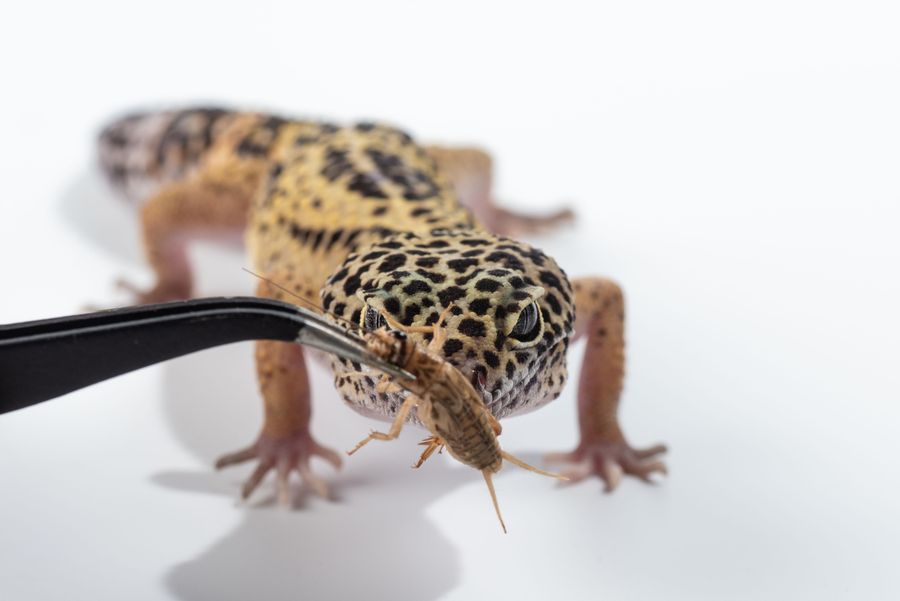
Gut-loading
Gut-load the insects first
An insect is only as good as what it has eaten. Feed the insects a proper gut-loading diet before your gecko eats them: for 24 to 48 hours (RSPCA), or at least 24 hours (VCA). Source: RSPCA, VCA
- Keep feeder insects in a large, well-ventilated tub. Feed them safe vegetables and keep them well hydrated. Source: RSPCA
- Feed them a formulated gut-loading diet or a complete invertebrate diet. Source: RSPCA, RVC
- Fresh greens such as turnip, collard, parsley, carrot tops, broccoli or cauliflower can go to crickets and mealworms. Source: VCA
Supplements
Calcium and vitamins for leopard geckos
Every source dusts insects with calcium. They differ on how often, and on vitamin D3. Source: RSPCA, PetMD, VCA, RVC, University of Liverpool vets
| Source | Calcium | Vitamin D3 | Multivitamin |
|---|---|---|---|
| RSPCA | A light dusting of a vitamin and calcium powder just before feeding, plus a dish of plain calcium always | Less is needed with good UVB | In the combined powder |
| PetMD | Dust every other day, alternating calcium with D3 and calcium without D3 | With good UVB, not needed every other day | Once or twice a week |
| VCA vets | Lightly dust with phosphorus-free calcium, plus a shallow dish of calcium always | Not mentioned | Not mentioned |
| Royal Veterinary College | Dust regularly, alternating calcium with a vitamin and mineral powder | Not mentioned | Alternating with calcium |
| University of Liverpool vets | Calcium with every meal | Not mentioned | Once a week |
Water
Do leopard geckos drink water?
Yes. Even though they come from dry country, they need water available all the time. Source: University of Liverpool vets, RVC Use a dish at the cool end and change the water every day, or straight away if it is dirty. Source: RSPCA, VCA RSPCA and VCA use a shallow dish; PetMD and the Royal Veterinary College want it big enough to soak in. Source: PetMD, RVC
Check your feeding routine
Five questions. The answer uses the sources on this page.
Answer the questions to see the result.
This checks your routine against written guidance. It cannot see your gecko. If it is losing weight or will not eat, see a reptile vet.
Off its food
Leopard gecko not eating?
Reptiles hide illness well, so the Liverpool vets advise a vet check for any gecko that refuses food, becomes quieter, loses weight, or passes abnormal droppings. Source: University of Liverpool vets PetMD lists refusing to eat among the signs to call a vet. Source: PetMD
- Check the warm end first. Wrong temperatures are linked to gut problems such as impaction. Source: RSPCA
- Cooler months. A gecko may eat less and sleep more in winter, but it should not lose weight. Source: RSPCA
- Weigh it. A thick tail is a sign of good health. Source: RSPCA Weight loss, or fast muscle loss along the back and tail, is a reason to see a vet. Source: University of Liverpool vets, PetMD
Questions people ask
Diet questions
What do leopard geckos eat?
Live insects: crickets, locusts, feeder roaches and calciworms as staples, with silkworms and hornworms for variety. Mealworms in moderation, and waxworms only as a treat (RSPCA, RVC, PetMD).
How often should I feed my leopard gecko?
Young geckos every day, adults every other day (RSPCA, PetMD). VCA gives every 1 to 2 days for juveniles and 2 to 3 times a week for adults.
How many crickets should a leopard gecko eat?
No source gives a fixed number. Offer one or two at a time, add more as they are eaten, and stop when your gecko loses interest. Then remove the rest (PetMD, Petco, RSPCA).
Can leopard geckos eat fruit or vegetables?
No. PetMD says not to feed fruit or vegetables. RSPCA allows only a washed dandelion or nasturtium flower once a month.
Can leopard geckos eat dead or freeze-dried insects?
Live insects are better. PetMD prefers live to freeze-dried, and the other sources feed livefood.
Do leopard geckos need calcium with D3?
PetMD alternates calcium with D3 and without, every other day. With a good UVB setup, less D3 is needed (RSPCA, PetMD). Follow the label.
Can leopard geckos eat mealworms only?
Not as the whole diet. The Royal Veterinary College says mealworms in moderation; give a variety, with crickets, locusts or roaches as the staple.
How long can a leopard gecko go without eating?
Our sources give no safe number of days. A healthy gecko should not lose weight, even if it eats less in winter (RSPCA). If it refuses food and loses weight, see a reptile vet.
Sources
We read each source on 27 November 2026. Where good sources disagree, we show the range and say so. How we check our numbers
- RSPCA Leopard gecko care page and care sheet
- PetMD Leopard gecko care sheet. Maria Zayas, DVM; reviewed by Ivan Alfonso, DVM; updated 8 May 2026
- VCA Animal Hospitals Leopard geckos: care and feeding. Gregory Rich, DVM, updated 19 August 2024
- Royal Veterinary College, Beaumont Sainsbury Animal Hospital Leopard gecko care factsheet, reviewed December 2024
- University of Liverpool Veterinary Practice Leopard gecko husbandry and care. Filipe Martinho, MRCVS
- Petco Leopard gecko care sheet, developed with and approved by a veterinarian
Written by: ScaleAndShed editorial team
Vet review: pending, this page has not yet been reviewed by a reptile vet
Updated 27 November 2026